The refined vision for the North Loop that I produced made some alterations to the original draft. Upon further investigation of certain sites, some ideas had to be scrapped or retooled, such as the rotaries connecting the east and west ends to the highway.
However, some ideas were expanded. In the Infill and Realignment map below, I showcase development opportunities were the North Loop to be covered and made into a transit corridor. These expand even as far as four blocks away from the loop, where parking lots and vacancies dominate the landscape.
Some parcels were given special attention instead of the entire block. Some easements were added or redrawn to allow for better use of space, such as between the 600-602 Parking Garage and the Holiday Inn, both fronting Admiral Blvd.
Thinking about land use, most of the development closest to the transit center (which I’ve positioned on top of the present-day Delaware St. Bridge) would be mixed-use, mid- to high-rise. This would match the form of much of the area, and act as a good transition to the neighborhoods outside the Central Business District.
Some outliers to this pattern can be seen in the parks places at the west end of the corridor and between Walnut and Grand, just north of Independence. Additionally, some areas would do better as just commercial or just residential, especially as that pattern of separation starts to naturally take place in areas like the River Market or Columbus Park. Some light industrial uses would all make sense in the far eastern part of the site, where that is already a pattern. However, the Paseo West district should not remain just light industry. That’s why I’ve suggested the introduction of small apartments and dense attached and detached single family homes in that area as well.
Phases for the project should be divided into four main parts. The first would begin construction of the highway cap over the transit center, and would close the loop to bus and truck traffic. The second would finish the western development and make a conclusive decision about how to redesign the I-70 gateway. The third portion would dismantle the MO-9 highway up to 3rd street, and the 4th would finally address the behemoth of the eastern cap. Additionally, each of the phases of this project would include an effort to spur growth on adjacent lots and blocks with potential (depicted in muted version of the same color as each phase).
Below is a picture of the transit center and some of the surrounding building massing, looking north. The station itself is loosely based on the Transportation Building by Louis Sullivan that was presented at the 1893 Chicago World’s Fair. In addition to that inspiration, it also calls up the design of the Denver Union Station transit hub, which connects passengers from the station at ground level to a busway that passes underneath going in perpendicular direction.
The Transportation Building, designed by architect Louis Sullivan – 1893 Chicago World’s Fair.
The above-ground portion of the station would have two drive lanes separated by medians on either side, flanked by two lanes for streetcar and buses. Trees, bushes, benches, and tables could fill the pedestrian plaza outside, but passengers could also take refuge under the roof of the transit center, even accessing shops, rest areas, and bathrooms indoors.
The transit center would be open-air to allow for pedestrians and vehicles to pass through it freely, but would include portions on either side that would be enclosed and air-conditioned. Additionally, it would have a vaulted skylight above.
Delaware Street looking north.
Same view as above, section diagram.
Overall, this project would be a massive undertaking, but in the words of one of Louis Sullivan’s contemporaries: “make no little plans”. Perhaps this or similar visions of the North Loop will not come to pass. Beginning big can have its upsides though, even if it means eventually arriving at something more realistic. It will take extraordinary revenue to make a return on this investment worth it, but that revenue itself requires extraordinary investment. So let us aim high in hope and in work, and build a new Northside; one worthy enough to carry on the legacy of the old.
The North Loop presents a great many difficulties in terms of how it might be redeveloped. The highway trench varies in depth at different intervals. The burms that flank it also vary, not only in depth but in length. Were they to be turned into blocks, they would be obscenely short, probably only long enough to contain one building until reaching the highway right of way. Another issue is found in the connections to the east and west, where the new development would connect to the remaining highway. Most optimistically, however, this project presents several opportunities to increase the scope from just redeveloping the trench to reconnecting several disparate communities and spurring growth downtown at large.
Firstly, to tackle the problem of short blocks and uneven terrain in the trench, I resigned myself to capping the highway. While this would require considerable earth-moving and would probably count as the highest expense for this project, I believe it is the only way to maximize use of this space.
Larger blocks will allow for greater development and better connection between the communities of the River Market and the CBD. It would also help encourage developers to repurpose the vacant or underutilized sites adjacent to the loop, such as the parking lots near 7th and Main Streets.
The North Loop not only steals value from the land to the north and south, but to the east and west. To the east, to accommodate several diverging directions of traffic, more and more blocks had to be torn asunder over the years. The gash that remains creates a canyon even more massive than the difference in distance between 6th street and Independence Avenue. This radical destruction of a junction of historic neighborhoods requires a radical solution to repair it, and that means continuing the cap.
Proposing not only to cap the North Loop, but to continue the cap across to the Paseo West neighborhood is not an easy ask, but ultimately if we are to revive these once-cherished places, we have to heal the wound that brought them low. The proposed cap on the east side would go as far North as Independence Avenue and far south as 10th Street, producing between fifteen and twenty new blocks of housing, commercial development, parks, light industry, office space, and small business incubators. While the upfront cost to build this infrastructure would indeed be staggering, the long-term return on investment could be massive.
However, this cap has the potential to interrupt highway traffic, so how might it handle that? To the north, where Independence meets Troost, a rotary could be installed that allows southbound traffic to exit into downtown. This rotary could also allow for downtown traffic to use the freeway by building a flyover across it that connects going northbound. A tight half-diamond interchange at 10th street would allow northbound highway traffic to exit into downtown, and for downtown traffic to enter going south.
Example of a tight diamond interchange. Red highlights the half that 10th street interchange would use.
To the west, connecting to I-70, another rotary could be placed beneath the existing flyovers. Some realignment of highway exits would be necessary to accomplish this redesign, but ultimately traffic would be able to freely flow in all directions but into the tunnel underneath the new highway cap.
This right of way would be restricted to buses and truck traffic to accommodate the necessary flow of bus rapid transit system, which would have a station underneath the former Delaware street bridge.
In addition to these major changes to the loop, others could include: realigning Oak Street as it approaches the former Heart of America Bridge, bringing MO-9 Highway to grade (and reusing the earth for part of the infill of the loop), and adding two connections to the west bottoms via the streetcar and a funicular.
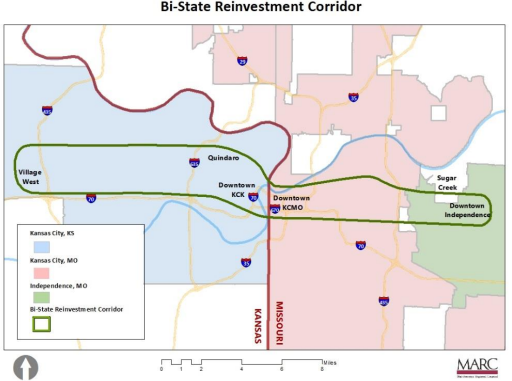
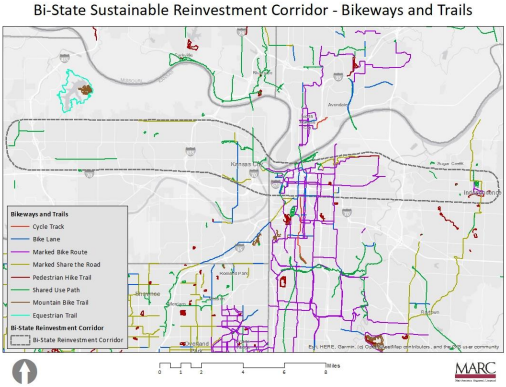
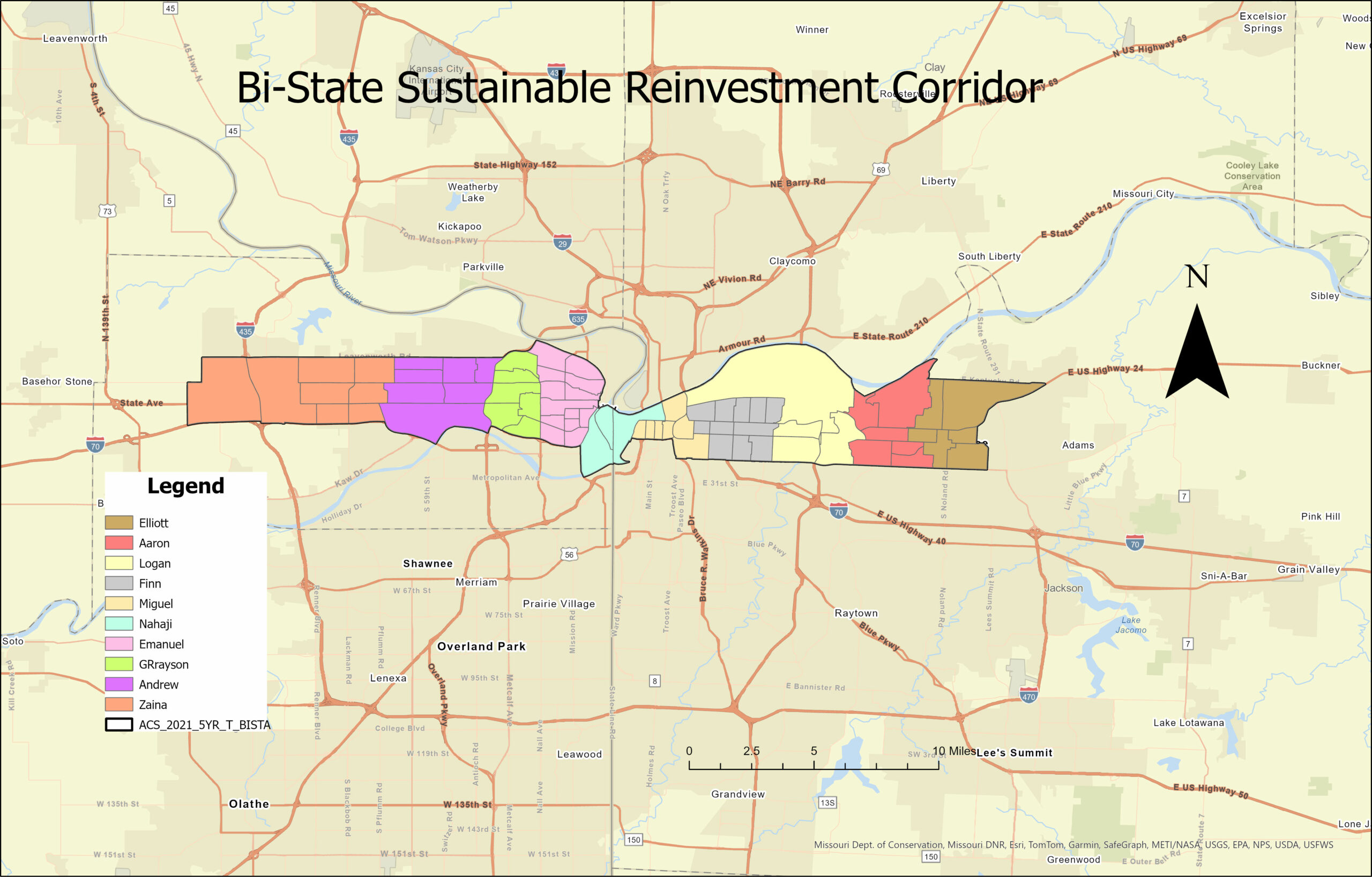
The trends and momentum of the South Loop project, the KC Streetcar, and the Bi-State Sustainable Redevelopment Corridor support this development. The success of the streetcar alone has shown the immense power of infrastructure and transit investments to spur economic growth downtown.
In the past twenty years, combined land and improvement values (measured in constant dollars) has skyrocketed in the south part of the loop. The “streetcar tax” that patrons of downtown businesses pay, has resulted in the service being free to use for everyone. Cordish has also made waves building luxury apartment properties in the form of One, Two, and Three Light. Clearly there is money to be made downtown for those willing to invest in it.
Among the new blocks produced by capping the North Loop and those vacant or underutilized parcels nearby, I envision primarily mixed-use housing, commercial, and office space, with housing taking priority. These could take the form of the contemporary platform development (five-over-ones) or they could be high-rises. As new development approaches the river market, however, massing should gradually diminish to match the scale of those buildings. The uses can still be mixed, but buildings should be no more than four or five floors tall.
Towards the east the same should be true. Closer to the government district and the east village buildings should take a greater size, but as they fan out in the directions of the Paseo West and Columbus Park neighborhoods, they should become smaller while remaining densely packed. Those neighborhoods could also see some greater separation of uses, particularly in terms of residential development. Single family detached homes, townhouses, small apartments such as four and sixplexes should dominate those neighborhoods, with compliment from neighborhood commercial.
These would give residents several different options for housing accommodations, while still all being within a few miles of the amenities provided by downtown. With luck, this would create a snowball effect of further and further development, funded by further and further habitation downtown, but in order to begin that trend, we must first make the North Loop someplace people want to live.
Board 1 of 3 showing axonometric and plan views of site.Board 2 of 3 showing section of the Delaware Avenue Bridge at three pivotal moments during development of the transit center.Board 3 of 3 showing phasing of the implementation of the North Loop Neighbors vision plan, with buildings color-coded by land use in the phases during which they are to be constructed.
Original vision plan courtesy of North Loop Neighbors. I classified the programmed buildings by land use, including the parks, new community center and new transit center.This is my idea for how the North Loop’s Interstates, U.S. Highways and Missouri State Highways could be realigned in the event of its removal.
Board 1 of 2.Board 2 of 2.Photo of site detailing safety fence along the Riverfront Heritage Trail preventing people from falling off the bluff’s edge at the old 4th Street Viaduct bridge terminus near 4th & Beardsley. Coordinates: 39°6’30.4″N, 94°35’27.1″W.Photo of screen wall obscuring an electrical substation on private property owned by Evergy near the Town of Kansas Bridge on 2nd & Main. Coordinates: 39°6’40.6″N, 94°35’1.6″W.Photo taken from 3rd & Main of planter-bollards. They, along with the brick planters with trees in them to the right serving as seating, constrict the flow of pedestrian traffic entering and leaving this pedestrianized section of Main Street abutting City Market to the immediate left. Coordinates: 39°6’35.5″N, 94°35’0.7″W.Photo taken at Main & Missouri of a poured concrete retaining wall separating the one-way portion of Independence Avenue between Oak and 5th & Broadway from the original street grid (as well as the original topography). The wall highlights the sheer amount of earth-moving required to ensure a semblance of adequate automobile circulation around the North Loop (let alone for the North Loop itself). The severely unactivated frontage of 529 Main across the street and the underutilized realm around the building and retaining wall create near-perfect conditions for a homeless encampment like the one obscured by overgrowth in the foreground to emerge in the intervening nooks and crannies of public space. Coordinates: 39°6’28.2″N, 94°34’58.8″W.Photo taken at Pacific & Forest of a noise barrier separating the east-southeast portion of the Columbus Park neighborhood from Interstate 29/35. While barriers such as this one may indeed spare the neighborhood from the highway’s noise pollution, it arguably ham-fistedly legitimizes the presence of the adjacent highway by making the implicit concession that the highway indeed yield harmful health effects, but in consolation for state and federal authorities making the value judgment that its perceived economic benefits outweigh its costs to one’s physiological health, the residents are effectively being told to simply forget about it behind the wall. 1958-vintage Sanborn maps and aerial photographs taken by the U.S. Department of Agriculture in 1963 show that a pedestrian bridge used to cross the interstate from Columbus Park to the Chouteau Courts housing project that once existed along Independence Avenue to the south. Coordinates: 39°6’31.9″N, 94°34’4.9″W.Photo taken at the pedestrian plaza nestled between 5th and Independence along Delaware St. This staircase railing is both wall and fence, and separates the brick alley in the public right-of-way to the left from the private plaza, facing Delaware in the bottom right, which is on the property of 510 Delaware. Although located in nominally private space, these elements of the public realm exist where they are in order to encourage public presence and use. Coordinates: 39°6’27.6″N, 94°35’4.2″W.Head-on view of the same above pedestrian plaza taken from Delaware, facing west-southwest. Another double-duty planter-bollard is seen here in the foreground, while seating, shade trees, and brick pavers are used in the middleground to inculcate an inviting feeling to pedestrians, whether tenants of the loft apartments in the left of the image or not. If not for the break in the iron railing created by the staircase scaling up the sides of the wall to meet the alley in the background, one might forget the alley is itself public space. Coordinates: 39°6’27.8″N, 94°35’3.1″W.
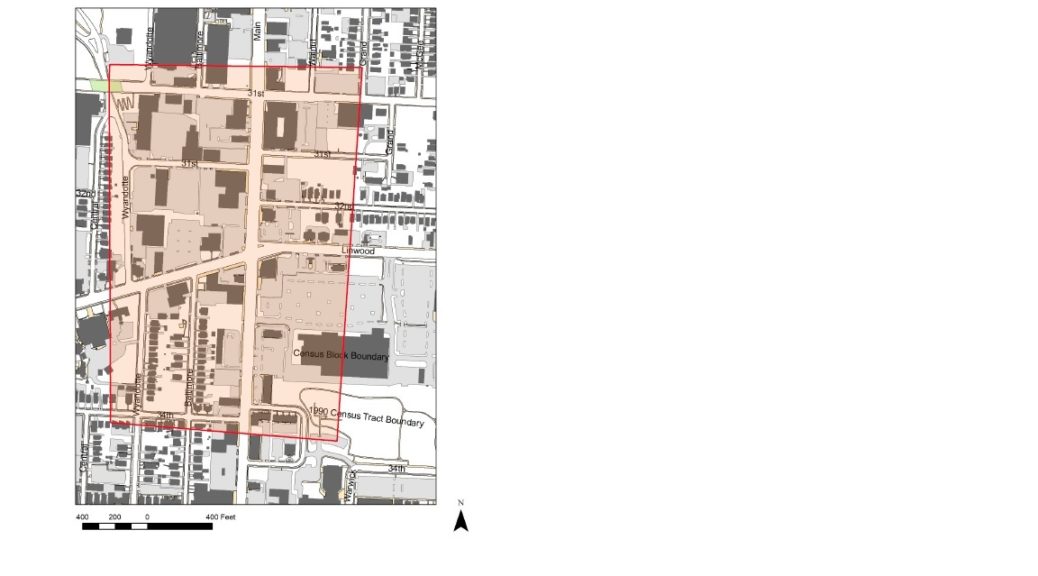
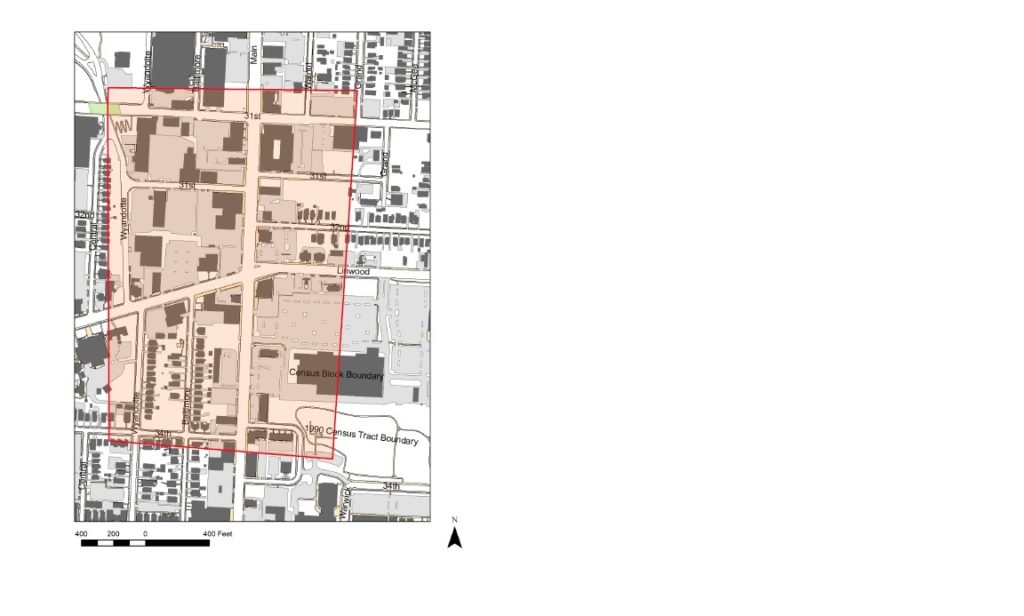
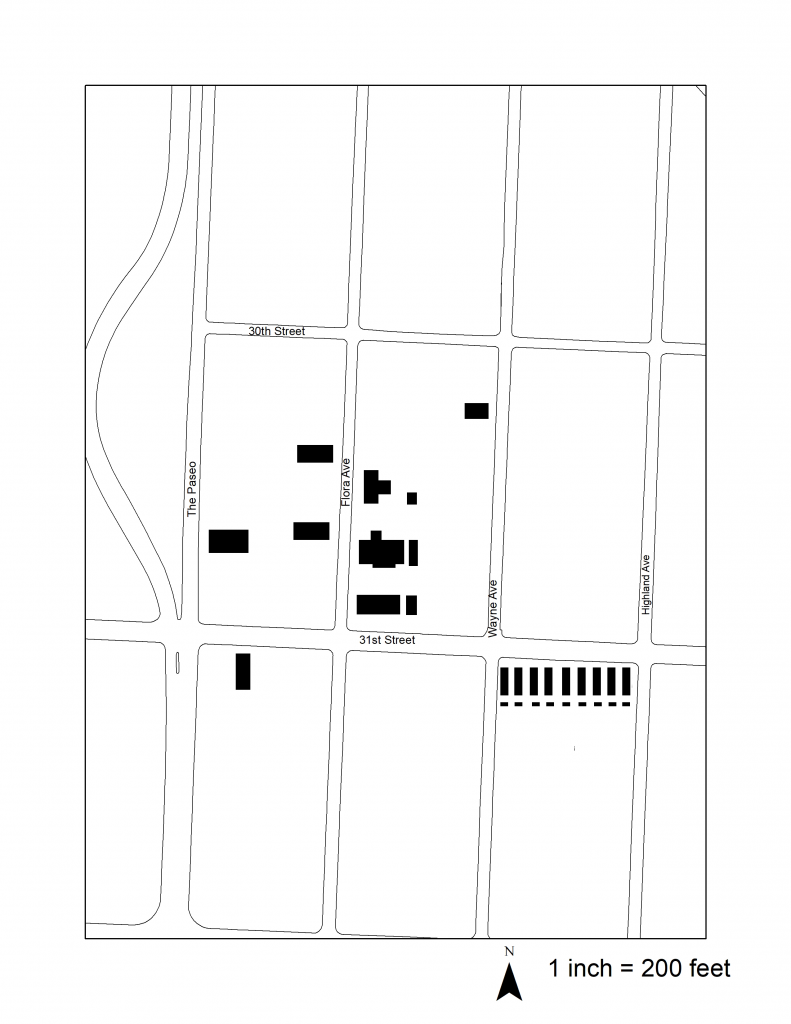
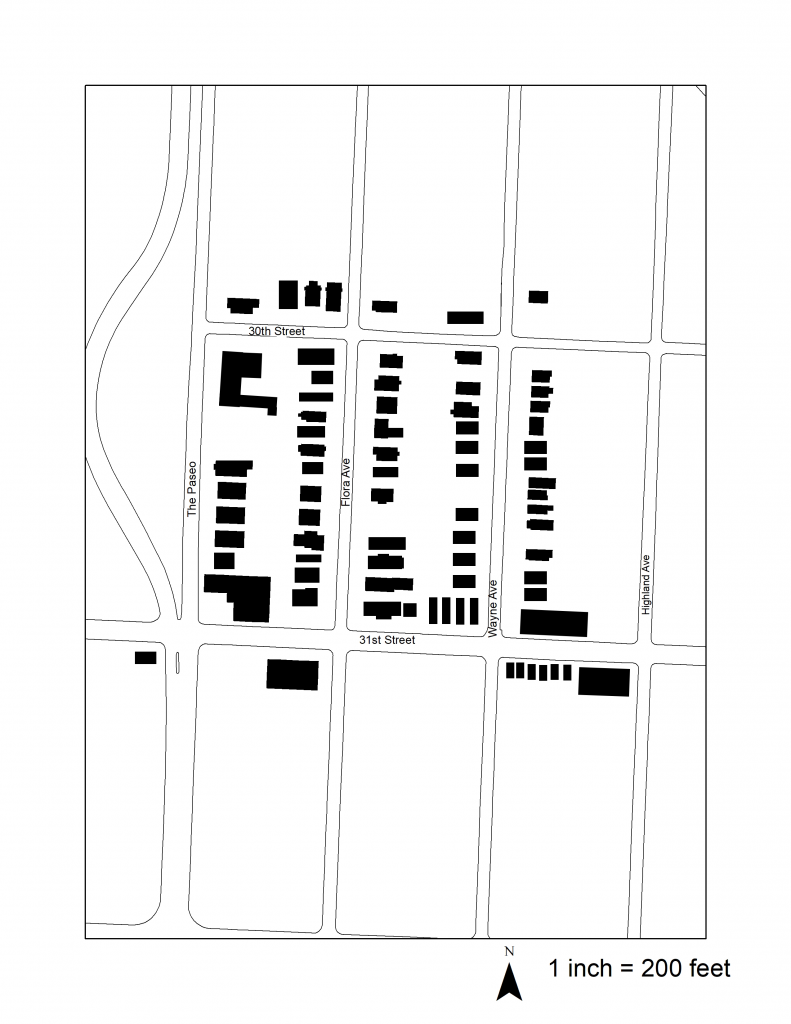
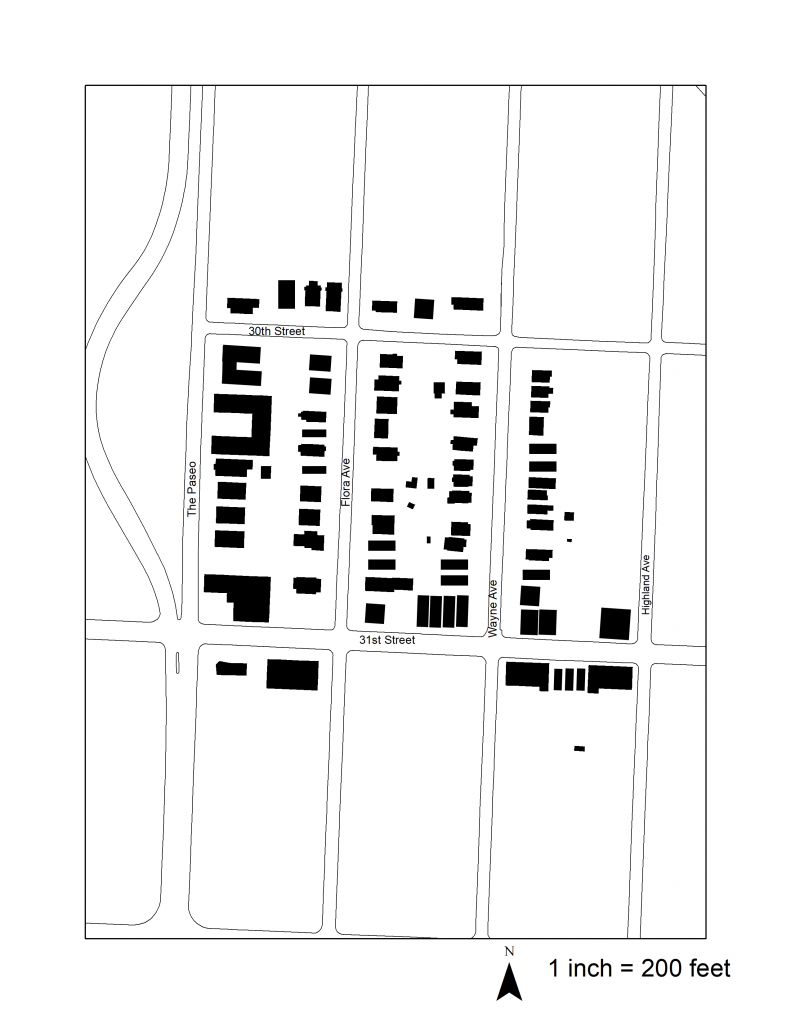
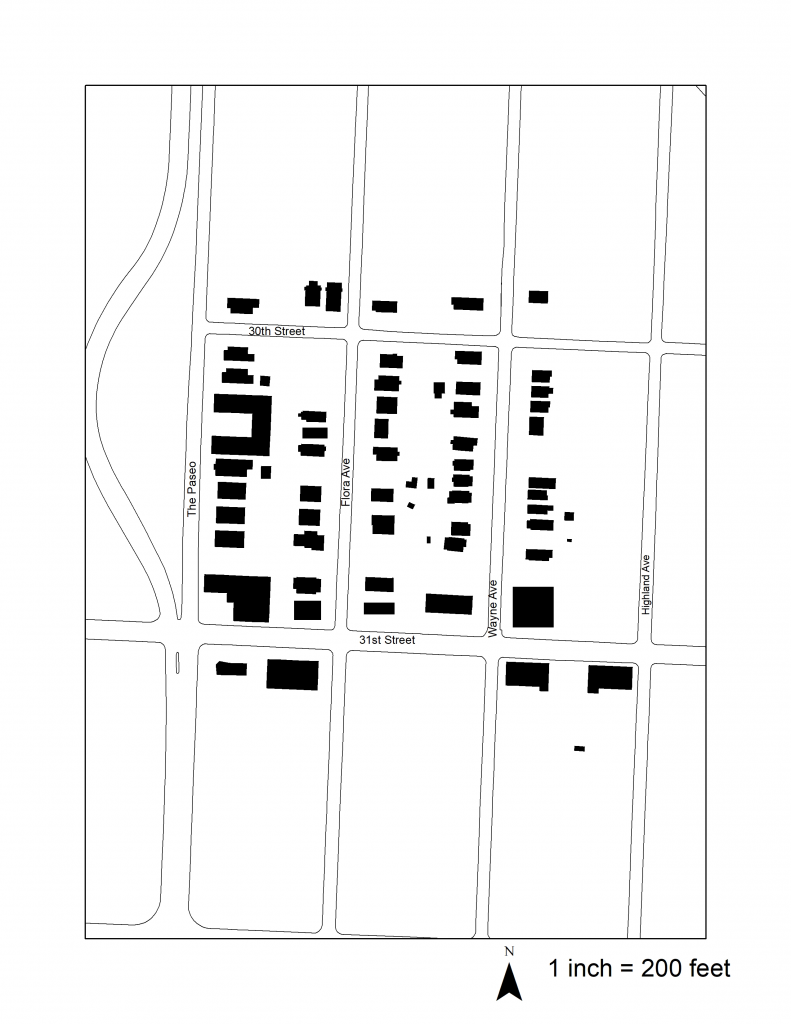
Figure-ground study of the North Loop area circa 1930. Source: Sanborn-Perris Map Company, Ltd. (1896/1907, 1925); Tuttle-Ayers-Woodward Company (1925).Figure-ground study of the North Loop area circa 1960. Source: Sanborn-Perris Map Company, Ltd. (1949, 1957, 1958).Figure-ground study of the North Loop area circa 1990. Source: Sanborn-Perris Map Company, Ltd. (1958); U.S. Geological Survey (1991).Figure-ground study of the North Loop area circa 2025. These are the existing conditions at the time of publication. Source: Kansas City, MO Parcel Viewer.
Most of the transit oriented development opportunities I chose to entertain as a priority for the North Loop Redevelopment Project find themselves located adjacent to the planned Transit Hub location I chose, Which is sandwiched between 6th St and Independence Ave on the Main-Delaware Bridge where there’s already KC Streetcar infrastructure built. The primary reason I made this area the focal point of my development opportunities is to ensure usage of the Transit Hub through its close proximity to high density housing developments. I also plan on implementing space housing along the proposed BRT route within the North Loop Corridor but this will act as secondary priority for the project as a whole.
This project has addressed many of the past generational planning errors that have negatively impacted Downtown Kansas City, and aims to conceptualize and implement key transit oriented and connective infrastructure improvements in order to revitalized the Bi-state corridor as defined my MARC.
Key Project Features/Goals:
Facilitate circulation of multiple types and examine connectivity and use by transportation mode.
Provide a reasonable timeline and design guide for a potential Transit Hub development while repurposing existing North Loop Infrastructure.
Design spaces that appeal to people utilizing form-defined space at a human scale.
Selectively increase/decrease development at key moments facilitating mass transit connectivity and non-motorized modes of transportation.
North Loop Site Plan and Regional BRT Alignment
Transit Hub Site Plan and Surrounding Development Design
“The public realm, which includes streetscapes and public spaces, is the setting for street life and community activities. Public realm elements, including pavement, street furnishings, and public art, should reflect the community identity, evoke civic pride, support daily activities, and foster civic life in the community.” (Fairfax County Board of Supervisors, et. al., 2018, Volume II, Chapter 5, 5A)
An element of the public realm is something that is foundational to place, and which can be translated to several other places. It can make or break the hospitality of that place. It can be implemented in a variety of different ways. Some examples of elements of the public realm include street furniture, lighting, paths and sidewalks, walls, or entrances.
One thing people may not think of as an element, however, is parking. However, it is necessary, especially in this day and age, to consider it and how it affects our ability to place-make. Accomplished urban designers and theorists have already written about the different types of parking and their implications. One among them, Christopher Alexander, developed a theory of auto parking which largely focuses on reigning in the runaway parking development that began in the 20th century and continues today.
Alexander’s criteria for parking mainly concern making parking lots small: “make parking lots small, serving no more than five to seven cars…”, reducing the percentage of parking in a given area: “do not allow more than nine per cent of the land in any given area to be used for parking…”, and shielding that parking from view: “put all large parking lots, or parking garages, behind some kind of natural wall, so that the cars and parking structures cannot be seen from outside.” (Alexander et al., 1977).
A small lot type at 3rd Street and Broadway Blvd.
These and more of Alexander’s theory went into my considerations for parking in the North Loop area of Kansas City, Missouri’s downtown. Developing my own theory, though, I developed six different core types of this element for study. They are:
Street parking
Angle parking
Parking garages
Parking lots
Micromobility parking
Guerilla/informal parking
Street parking is one of the older, more common, and more intuitive forms of parking. One simply drives to their destination, stops their vehicle on the edge of the street, and leaves it on foot. There are certain advantages to this form of parking. It is relatively unobtrusive to street design, at most requiring slightly more right of way width for the street. It allows for direct travel to a destination, but only if there is unoccupied parking space nearby. In a city or region where people heavily depend on cars for travel, this form of parking can run out quickly. It can have people circling blocks, adding to air pollution and increasing the likelihood of collisions.
Harrison Street & Missouri Avenue – looking west on Missouri.
The location I chose to demonstrate this type is in the Columbus Park neighborhood, at Harrison Street and Missouri Avenue – looking west on Missouri. This area is an historic development with a mix of single-family homes, small apartments, and neighborhood commercial. Parked cars are rarely a nuisance here and finding parking is usually not difficult.
Another form of street parking is angle parking, although this type can also be seen in surface lots. Historically, these have been “head-in” spaces where cars pull forward into the space. As design standards have changed, however, back-in angle parking has started to become more popular. The advantage to this specific type of parking is its relationship to safety for cyclists and pedestrians. Instead of backing into blindly into traffic and hitting cyclists (as in the case of head-in angle parking) drivers now have better visibility when leaving the space.
“Dozens of cities across the country have solved the problem simply reversing the angles. Cars now pull just past the parking space and then back into it. It is like parallel parking, but much easier. To pull out of the space, motorists look left for approaching traffic and then pull forward.” (BikeWalkKC).
The example of angle parking below, at 401 Deleware Street, looking south, shows just this. Cars proceed one way down Deleware Street, then back in to angle parking spaces. This is especially important for deleware, considering cars share that stretch of it with the streetcar. This design helps prevent collisions.
401 Delaware Street – looking south on Delaware.
Parking Garages seem to solve some of the issues of street parking too. They allow for denser concentration of parked cars, meaning people may be able to access their destination relatively close to where they park, while maintaining the urban environment. However, when not controlled, they can become more common in an area than actual buildings for humans. Not to mention too, they are costly to build, especially when building underground. Here are some estimates for reference:
A surface lot is $1,500-$10,000 per space (economical).
An above ground garage is $25,000-$35,000 per space (balanced).
An underground garage is $35,000-$50,000 per space (expensive from excavation).
(Dcparkinglot, 2024).
MARC Garage (left), former Hilton Inn Garage (bottom right), and State Street Bank and Trust Garage (top right) – 7th and Washington Streets (as viewed from 5th and Washington – looking south).
The parking garages in the pictures above consist of the MARC garage to the left, the former Hilton Inn garage on the bottom right, and the State Street Bank and Trust garage in the top right. These all cluster around 7th and Washington Streets. This area is relatively dead, even during large events downtown. Partly, this is due to vacancy (the Hilton Inn was closed and demolished in 2002 and the State Street Bank building has sat vacant for some time too). But I have to imagine that even when these were operational, the area was not much more invigorated. Parking does not directly precipitate human activity (except perhaps road rage over a stolen space). It must be carefully crafted to invite a means for people to get to their destination without destroying the place those same people want to arrive at. To quote Jeff Speck:
“the twin gods of Smooth Traffic and Ample Parking—have turned our downtowns into places that are easy to get to but not worth arriving at.” (Speck et al., 2022).
In my study of North Loop parking, I used Kansas City Parcel Viewer to get an estimate of how much of the area was surface lots. I paired this with a study of the highway surface area. The results were as follows:
The study area measured in at around 11.5 million feet2
Parking lots took up around 1.2 million feet2
The highway (or MODOT right of way) equaled approximately 4.3 million feet2
Converting these to percentages, surface parking lots alone took up about 10% of the land area, while highways took up about 30%. These numbers don’t account for parking garages, however, nor do they fully count the highway’s area, because they can’t capture landscaping on either side of the highway lanes. Accounting for these errors, we count intuit that between these twin gods (smooth traffic and ample parking) they account for nearly 50% of the study area.
Parking lots share some of the same issues as garages, but many of them are inverse. While cheaper to build, they can take up far more surface area than garages past a certain number of spaces.
The area chosen to showcase this type is depicted below and consists of four parking lots on all corners of 7th and Main Streets. The photo was taken from the top of the Flashcube Apartments facing north/northeast. The pattern of lots actually continues out in several directions from these, creating vast swaths of underutilized, inhospitable land. This paired with the freeway (the other twin god) makes for an ocean of disconnectivity between the CBD and the River Market neighborhood.
Parking lots on corners of 7th and Main Streets as viewed from the rooftop of Flashcube Apartments (looking north/northeast).
Micromobility parking, while perhaps not conventional, is still a form of parking, and can be a way to mitigate some of the issues with parking for automobiles. Micromobility refers to bicycles, scooters, and the like, and parking for them is much the same as parking for cars, only it takes up more less space.
5th and Delaware Streets – looking west on 5th.
As shown above, this area of 5th Street near the intersection with Deleware is reserved for parking scooters and bikes. Racks are included, along with flexible delineators and street paint. This mitigates the issue of scooters and bikeshares often being left strewn haphazardly on sidewalks and streets, while also helping to slow traffic by reducing the width of the right of way for part of the street. This issue of haphazard placement is part of another form of parking I’ve termed “Guerilla Parking”
Guerilla Parking (or informal parking) is what happens when there is nowhere (or nowhere convenient) to park legitimately. In the case of the scooter shown below at the corner of 6th and Washington Streets, there were likely no other better options for the individual who was riding it.
Corner of 6th and Washington Streets – looking north.
Guerilla parking can come in many different shapes an sizes, though. Below is a picture of the parking for the Chiefs’ victory parade in 2024 taken at the corner of 26th and Jefferson Streets, looking south. This is by far an extreme case, but it just goes to show that parking will never be able to accommodate everyone if everyone must drive a car to get where they need to go.
Chiefs Parade Parking, 2024. Photo taken from 26th and Jefferson Streets, looking South.
Other more common forms of Guerilla parking including parking payment delinquency or parking in fire lanes or other restricted areas. There are several strategies we might utilize to address these issues. One initial strategy might be to better enforce the rules we’ve created surrounding illegal or delinquent parking. We might make it more convenient to pay for parking with technology. And, from a more long-range perspective, we should be reducing our dependency on automobile transportation in favor of multi-modal accommodations like transit and micromobility. We should also be infilling our downtowns to make them more walkable, and, as we build out, doing so more incrementally and more densely.
Intervening in the study area, I chose to address the egregious surface lots near Flashcube Apartments at 7th and Main streets. Applying Alexander’s Small Lot theory, I simulated building massing on one of the lots, leaving a fraction of the lot for parking. This area of the lot, a row of spaces along the building edge of Flashcube, would allow for residents, workers, and visitors to still park if need be, but regular parking could be redirected elsewhere, such as underneath Flashcube where there exists an underground garage. Transit could also be fortified to reduce the need for parking. There is a streetcar stop just outside the building. Garden walls should be paired with trees and other plantings to mask the lot from view and soften the area.
Existing Context, 7th and Main Streets.
Plan View – Reprogramming of parking lot at 701 Main Street.
Axonometric – Reprogramming of parking lot at 701 Main Street.
There exist several other opportunities for reducing or changing parking in the North Loop. Parking is a necessary amenity, and can indirectly facilitate human interaction and economic growth in an area, but its implementation should be measured and planners should be firm in limiting its use.
Citations:
Alexander, C., Ishikawa, S., & Silverstein, M. (2010). A pattern language: Towns, buildings, construction. Oxford Univ. Pr.
Dcparkinglot. (2024, August 20). Cost of building a parking garage. D & C Parking Lot Maintenance. https://dcplm.com/blog/cost-of-building-a-parking-garage/